Online School of Cocktailory 🍸
For drinking #alonetogether
Section 104: Daisies
It’s more liquor. So much liquor. Stay with me for a sec.
If Section 101, the Old Fashioned pattern was core liquor + sugar + garnish, and Section 102, the Martini pattern was less core liquor + milder alcohol like wine or vermouth + garnish, then we follow the same progression here.
Section 103, the Daiquiri (and sours) was core liquor + sugar & juice to balance + garnish, so Section 104, the Daisy (Sidecar/Margarita style) is less core liquor + less sugar & juice + milder alcohol like fruity liqueurs + garnish.
Hence a Sidecar, a Margarita, and a Cosmopolitan being in the same chapter. Still with me? Ok cool.
As far as cocktail ingredients go, liqueurs are alcohol, flavoring, and sweetener rolled into one, but it’s hard to know what they’ll taste like or how much you’ll need in a cocktail until you try it. Luckily the ABV has to be listed on the bottle, and most are at least 20% to be shelf stable. Low ABV is usually sweeter, and then there’s green Chartreuse at a whopping 55%.
Just like we learned in the bitters experiment, some bottles have an artificial chemical flavor which don’t make for yummy cocktails, so it’s best not to bargain bin shop for liqueurs and just pick a couple good ones at a time.
Liqueurs can be made from either a neutral base spirit (like Cointreau is) or from brandy (like Grand Marnier) and infused or macerated with fruits, peels, herbs and other spices. Orange liqueurs being the most common, followed by St. Germain, an elderflower liqueur also referred to as bartender’s ketchup because it goes good with everything. Herbal liqueurs are blends of all kinds of stuff and were originally touted as medicinal elixirs to cure all ills; Chartreuse being made by Carthusian monks near the French Alps, and Bénédictine created by Don Bernardo Vincelli, a Bénédictine French monk in the 1500’s. They pretty much come in every flavor imaginable, so it’s up to you or your cocktail book to decide what sounds good together.
Ok, experiment time!
Because there are so many liqueurs and their proportions in each recipe are so varied based on how sweet or strong they are, I propose the Champagne test as our blank slate to practice on, but you’re welcome to try this with vodka or soda water (like we did with the bitters) or any other fairly neutral base. We’re going to make 3 cocktails again, so you’ll need 3 liqueurs to compare.
–The Recipe (swap at will)-
2 oz. champagne
1/2 oz. fresh lemon, lime, or other juice
1/4 oz. simple syrup
3/4 oz. of whatever your liqueur de jour is
– Shake the juice, syrup and liqueur with ice and strain into a chilled coupe or flute. Top with the 2 oz. of chilled champagne.
-Some liqueurs at 3/4 oz. will overpower the other ingredients, while others will be barely recognizable, but testing the flavor and brand you have to start with like this will let you know how to mix it in the future, and tell you if it requires simple syrup, or if the liqueur is sweet enough on its own.
Let me know what you made in the comments and we can test more flavors with more kitchen scientists. Cheers!
 Jet Tries
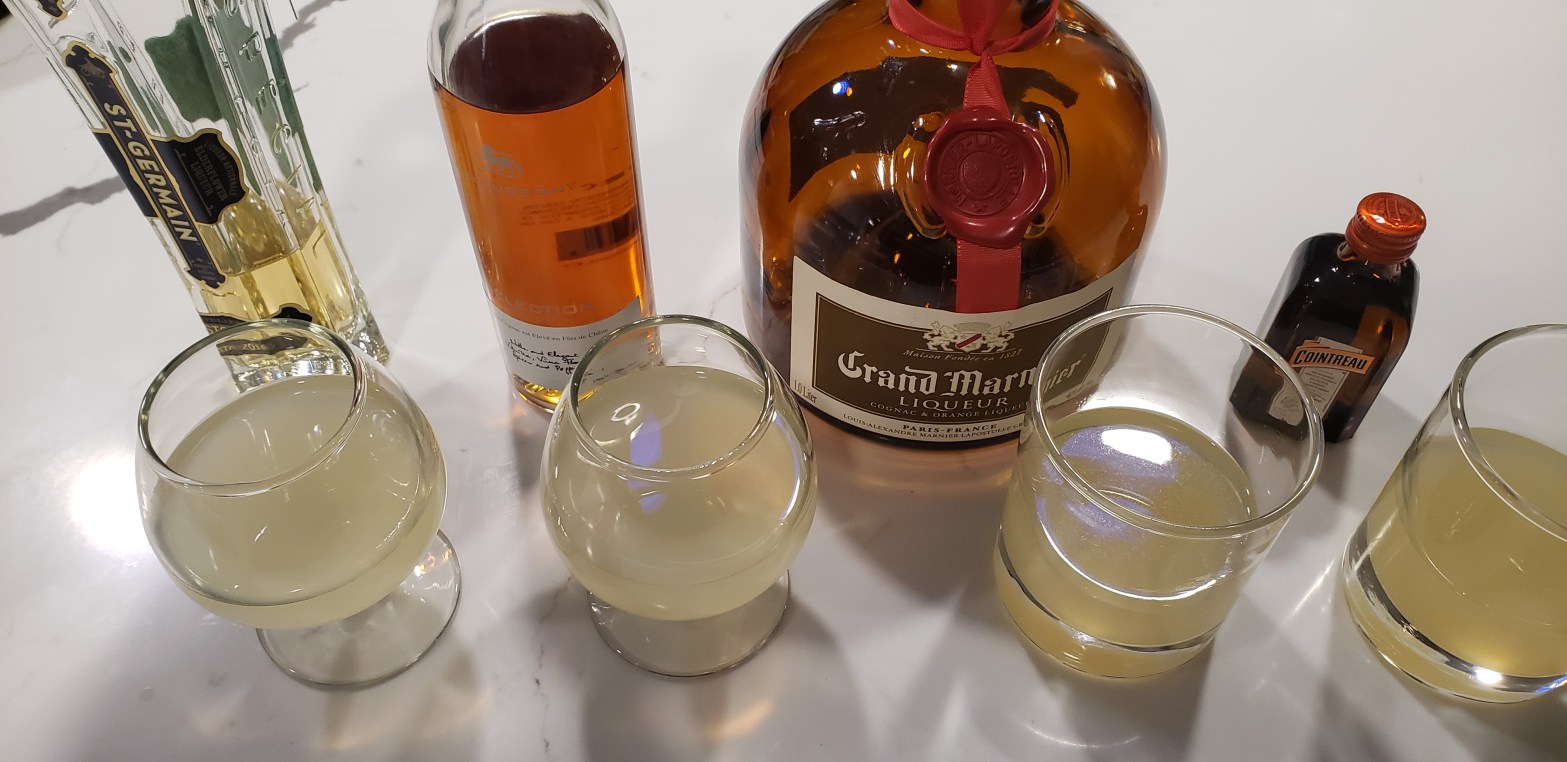
Ok champagne cocktail test, round 1:
Grand Marnier vs. Cointreau, both with lime
Grand Marnier version = freaking yum. I would drink this combo forever and always. It’s sweet, and a little caramely. Mmm.
Cointreau version = kinda tart. Tastes more juicy, but needs more sweetener to reach balance. Ah, that’s better, but now it’s less flavorful than the Grand Marnier version. I guess if you want more tart fruit pucker in your drink you’d buy this liqueur instead.
Champagne cocktail round 2:
St. Germain vs. A. de Fussigny eau de vie cognac, both with lemon
St. Germaine version = noms but a little syrupie. Too heavy on the liqueur, so I’m “watering” it down with more champagne to reach a good balance. And it’s a little one-note for a cocktail. Sweet, but not much smell. Added 2 drops of cassia chamomile bitters. Better.
Eau de vie version = has that weird barrel cognac smell, no surprise. I really liked this stuff plain, it smells like christmas cookies and is really smooth, but mixed the good flavors are drown out by lemon, so you just have barrel scented lemon champagne. Not a winner.